
Ginkgo
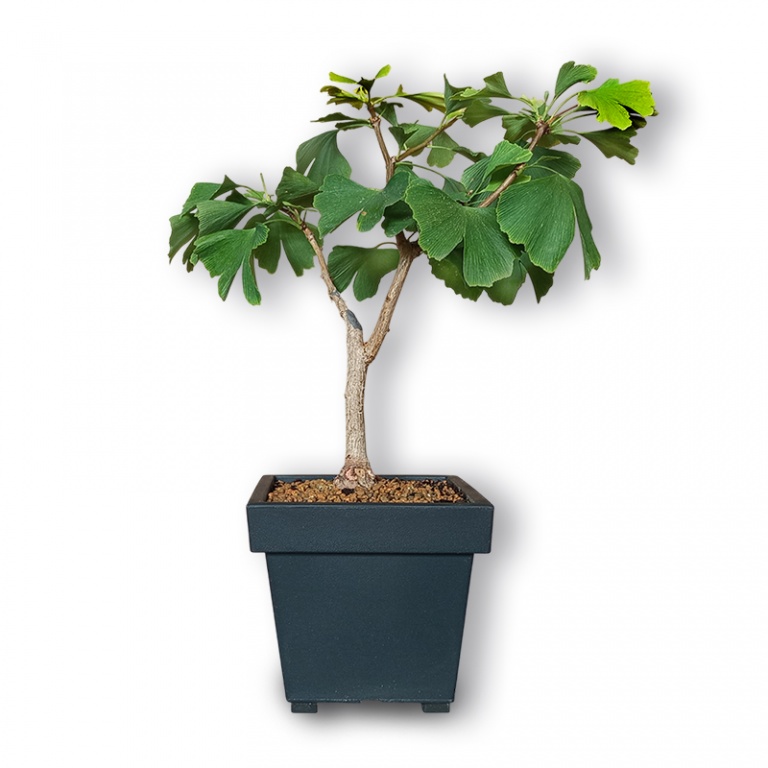
Ginkgo (Ginkgo biloba) - relict deciduous tree (has existed for ~200 million years). It is the oldest tree on earth.
It grows very slowly: ginkgo is a bonsai for the patient.
Location
Does not grow well indoors; ideal: street, balcony, garden.
Tolerates cold well, but not heat in a pot.
Soil
50% akadama
25% pumice
25% lava drainage (required)
You can add 10% organic matter (see here)
Pot
In the early stages: deep training container.
For a formed bonsai: shallow, but wider than other bonsai.
Watering
Water only after the top layer has dried.
In summer — often, but without overwatering.
In winter — minimally.
It tolerates light drought better than overwatering.
Lighting
Full sun or light partial shade.
Minimum 5–6 hours of sun.
Temperature
Summer: up to +30 °C (with good watering).
Winter: a dormant period at +5...–10 °C (basement, cold balcony) is required.
Without cold wintering, ginkgo weakens and dies.
Pruning and shaping
The trunk is shaped at a young age.
Guiding pruning and minimal wire.
Apply wire carefully - the bark is easily damaged.
Pruning of shoots is carried out only in spring
Shorten long shoots, do not touch spurs.
Reacts poorly to heavy pruning.
When the shoot grows to 6–8 leaves, pinch it back to 2–3
Do not do this every year, but according to the condition of the tree.
Does not branch naturally.
Forms long shoots and short spurs (leaves form on them).
Repotting
Young tree: once every 2 years
Mature bonsai: once every 4–5 years
When repotting:
Shorten no more than 20–25% of the roots
Never cut the main root completely
Fertilization
Spring–summer: organic fertilizers (see here)
Fall: potassium, phosphorus, no nitrogen.
Diseases and problems
Common problems:
Yellowing of leaves in summer due to overwatering.
Poor growth due to lack of sunlight.
Leaf fall out of season due to lack of wintering.
Ginkgo is practically resistant to disease and pests.