
Chinese Elm
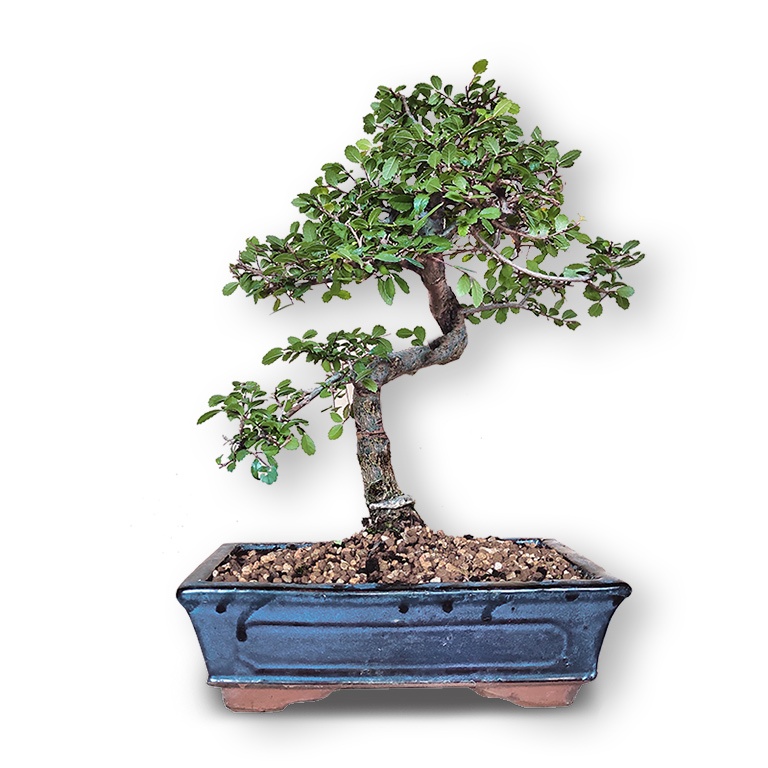
Chinese elm (Ulmus parvifolia)- is one of the best kinds of bonsai: strong, reliable, branches well, and forgives mistakes.
Deciduous/semi-evergreen tree.
Origin: China, Korea, Japan.
It's considered the gold standard for bonsai, perfect for learning.
Leaves are small and easy to reduce in size.
Bark: forms a characteristic “spotted” pattern with age.
Tolerates frequent pruning well.
Quickly forms a dense crown.
Thrives both outdoors and indoors (with restrictions).
Suitable for beginners to masters.
Location
Outdoors: April–October.
Winter — cold wintering.
Acceptable indoors year-round — only with supplemental lighting and a cold period.
Without a dormant period, the tree will weaken over time.
Lighting
Full sun or light partial shade, 6–8 hours of light.
Indoors with supplemental lighting from a grow light for 10–12 hours (see here)
Lack of light results in large leaves and elongated shoots.
Temperature and wintering.
Summer +18...+30 °C
In winter 0...+8 °C
Up to –10 °C is acceptable (in a pot with protection).
Wintering is essential for a long life.
Temperature and humidity control - sensor (see here)
Soil
Elm likes moderately moisture-retentive but well-drained substrate.
40% akadama
30% pumice
20% lava (drainage)
10% organic matter (see here)
Watering
Water when the top layer dries out.
In summer — abundantly.
In winter — moderately.
Elm does not like overwatering or drying out.
Control watering with an indicator (see here).
Fertilizers
During growth: balanced (see here)
In autumn: less nitrogen
In winter: do not fertilize
Formation
Use: pruning, wire, guide shoots
Elm heals wounds very well.
Prune shoots that have grown to 6–7 leaves to 2 leaves.
Frequent pinching stimulates leaf reduction.
Aluminum wire, check every 2–3 weeks.
Can be used year-round.
Transplanting
Young plants: once every 1–2 years
Mature plants: once every 3–4 years
Remove up to 30% of the roots when transplanting
Form nebari
The best time is early spring.
Diseases and pests
- Aphids
- Spider mites
- Fungal diseases in damp conditions.
Prevention
- Air
- Sun
- Clean crown
- Neem oil preparations (see here)
Common mistakes made by beginners
- Lack of wintering
- Lack of light
- Infrequent pruning
- Overwatering