
Podocarpus
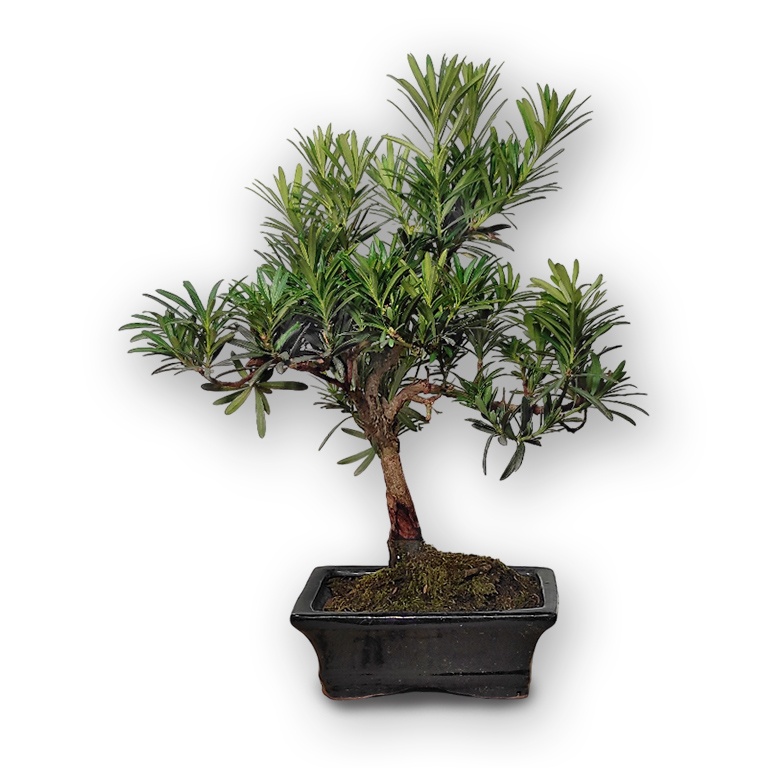
An evergreen coniferous plant from the tropics and subtropics.
Suitable for beginners and advanced bonsai enthusiasts.
Podocarpus is the ideal “indoor coniferous bonsai.”
Features
- Tolerates shaping well;
- Recovers easily after pruning;
- Can be grown indoors;
- With the right agricultural techniques, the leaves become smaller;
- Does not like overwatering;
- The trunk thickens slowly;
- Does not respond well to sudden changes in conditions.
Lighting
- Bright diffused light 6-8 hours a day;
- East or south window;
- Partial shade is acceptable, but growth slows down and leaves elongate;
- Midday summer sun causes burns;
- In winter, a phytolamp is required in the apartment (10-12 hours), (see here)
Temperature
Spring–summer: +18...+26 °C
Autumn: +15...+20 °C
Winter: +10...+15 °C
Does not like: drafts, dry air from heat radiators
Can be kept on the balcony in summer if there are no night cold temperatures.
Watering
- It is better to let it dry out slightly than to overwater it.
- Allow the top layer (1-2 cm) to dry out.
- Water 2-4 times a week in summer.
- In winter: once every 7-10 days.
- Do not allow the soil to remain constantly moist.
- Do not water on a schedule.
Use a watering indicator to monitor (see here)
Air humidity
- Moderately humid air
- Spray 1–2 times a day (in summer)
- Do not spray with cold water
- In winter - a tray with wet pebbles (see here)
Use a humidity and temperature sensor to monitor conditions pumice
Soil
Ideal substrates:
70% akadama;
20% kiryuzuna;
10% lava (drainage).
50% akadama;
25% pumice;
25% lava (drainage).
(see here)
Organic material also can be added 10% (see here)
Transplanting
Young plants: once every 1–2 years.
Mature plants: once every 3–4 years.
Best time: spring before active growth.
Shorten the roots by 20–30%.
Remove thick and twisted roots.
Do not disturb the root collar.
After transplanting, keep in partial shade for 2 weeks.
Shaping
Pruning branches: done in spring and summer.
Leave 2–3 pairs of leaves.
The more often you prune, the smaller the leaves will be.
Pinching: done regularly with sharp scissors.
Wire
Use aluminum wire when shaping the trunk.
Apply in spring and check every 2-3 weeks.
The bark of the podocarpus is very delicate.
Fertilizers
During the growth period: balanced (see here)
In autumn: less nitrogen.
In winter: do not fertilize.
Diseases and pests
- spider mites
- scale insects
- mealybugs
Symptoms:
- yellowing
- sticky leaves
- cobwebs
Treatment:
insecticides
isolate the plant
Prevention:
- fresh air
- good drainage
- regular inspection
- neem oil preparations (see here)
Common mistakes
- overwatering;
- lack of light;
- heavy soil;
- overwintering in warm conditions;
- heavy pruning in winter.